
Your Vehicle. Your Business. One Platform.
Sign in securely to manage bookings, vehicles, and services in one place.
Log in
Fast access to your dashboard
Use this if you book services and manage your account.
Both options use the same email and password. Business highlights seller tools after you sign in.
Don't have an account? Register now
Join CarServicesLTD
Create a user or business account in one place.
Top 10 Types of Farming in India – Benefits & Uses
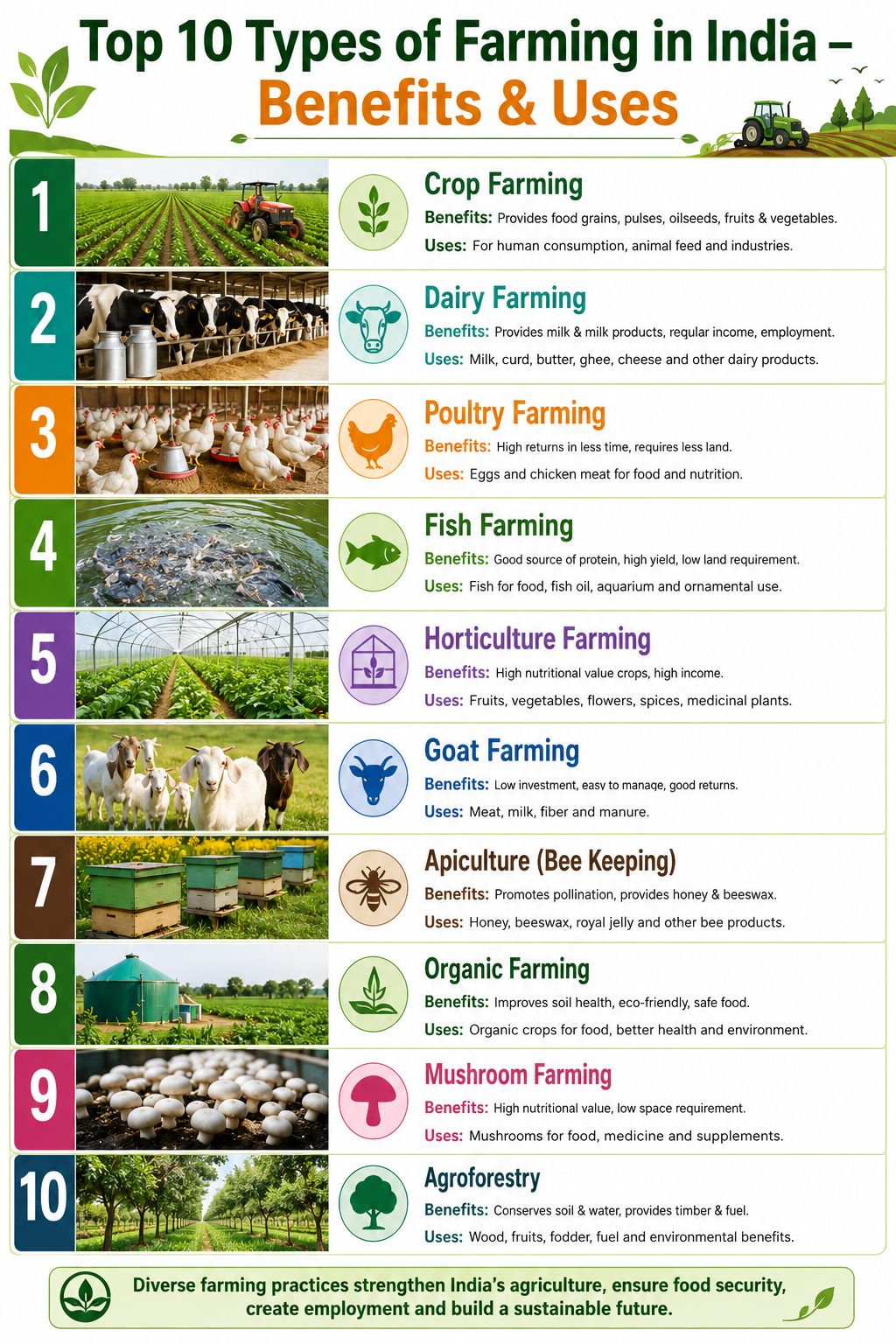
What is Farming?Farming is the practice of cultivating crops and raising livestock to produce food, raw materials, and other agricultural products. Agriculture plays a vital role in India's econom...
What is Farming?
Farming is the practice of cultivating crops and raising livestock to produce food, raw materials, and other agricultural products. Agriculture plays a vital role in India's economy, providing employment to millions of people and contributing significantly to the country's GDP. Due to India's diverse climate, soil types, and geographical conditions, different farming methods are practiced across the country.
Understanding the various types of farming can help farmers choose the most suitable method based on their land, climate, and resources. Here are the top 10 types of farming in India, along with their benefits and uses.
1. Subsistence Farming
Subsistence farming is one of the oldest and most common farming methods in India. In this type of farming, farmers grow crops primarily to meet the needs of their families rather than for commercial sale.
Benefits:
- Provides food security for rural families.
- Requires less investment.
- Utilizes local resources effectively.
Uses:
- Commonly practiced in rural and tribal regions.
- Produces staple crops such as rice, wheat, maize, and pulses.
2. Commercial Farming
Commercial farming focuses on producing crops and livestock for sale in local, national, and international markets. Modern machinery, fertilizers, and irrigation systems are widely used.
Benefits:
- Generates higher income for farmers.
- Increases agricultural productivity.
- Supports economic growth.
Uses:
- Production of cash crops such as cotton, sugarcane, tea, coffee, and tobacco.
3. Terrace Farming
Terrace farming is practiced on hilly and mountainous regions where flat land is limited. Farmers create step-like terraces on slopes to cultivate crops.
Benefits:
- Prevents soil erosion.
- Conserves water efficiently.
- Makes farming possible on steep slopes.
Uses:
- Common in states like Himachal Pradesh, Uttarakhand, and the northeastern regions.
- Suitable for rice, vegetables, and fruits.
4. Dry Land Farming
Dry land farming is practiced in areas with low rainfall and limited water availability. Farmers grow drought-resistant crops that require less moisture.
Benefits:
- Efficient use of limited water resources.
- Reduces dependency on irrigation.
- Suitable for arid and semi-arid regions.
Uses:
- Cultivation of millet, sorghum, pulses, and oilseeds.
5. Wetland Farming
Wetland farming is carried out in regions receiving high rainfall or having abundant water resources. The land remains moist throughout the growing season.
Benefits:
- Supports high crop yields.
- Ideal for water-intensive crops.
- Enhances soil fertility.
Uses:
- Primarily used for rice cultivation.
- Common in Kerala, West Bengal, Assam, and coastal regions.
6. Organic Farming
Organic farming avoids the use of synthetic fertilizers, pesticides, and genetically modified organisms (GMOs). It relies on natural farming techniques and eco-friendly practices.
Benefits:
- Produces healthier food.
- Improves soil health.
- Reduces environmental pollution.
- Promotes sustainable agriculture.
Uses:
- Growing vegetables, fruits, grains, and herbs for health-conscious consumers.
- Increasingly popular across India.
7. Cooperative Farming
In cooperative farming, a group of farmers pool their land, resources, labor, and capital to achieve better productivity and profitability.
Benefits:
- Reduces farming costs.
- Increases access to modern equipment.
- Enhances bargaining power in markets.
Uses:
- Suitable for small and marginal farmers.
- Helps improve overall farm efficiency and income.
8. Crop Rotation
Crop rotation involves growing different crops on the same field in a planned sequence over multiple seasons. This practice improves soil fertility and reduces pest problems.
Benefits:
- Enhances soil nutrients.
- Reduces pest and disease outbreaks.
- Improves crop yields.
- Minimizes dependence on chemical fertilizers.
Uses:
- Commonly practiced in sustainable agriculture.
- Popular crop combinations include cereals, legumes, and oilseeds.
9. Sustainable Farming
Sustainable farming focuses on meeting current food needs while preserving natural resources for future generations. It combines environmentally friendly techniques with profitable agricultural practices.
Benefits:
- Conserves water and soil resources.
- Protects biodiversity.
- Improves long-term farm productivity.
- Reduces environmental impact.
Uses:
- Integrates crop production, livestock management, and renewable farming methods.
- Suitable for modern eco-conscious agriculture.
10. Ley Farming
Ley farming combines crop cultivation and livestock grazing on the same land. Farmers alternate between growing crops and maintaining grasslands for grazing animals.
Benefits:
- Improves soil fertility naturally.
- Provides fodder for livestock.
- Reduces soil degradation.
- Enhances farm profitability.
Uses:
- Widely practiced in mixed farming systems.
- Supports both crop and dairy production.
Conclusion
India's agricultural sector is incredibly diverse, with farming methods adapted to different climates, terrains, and economic needs. From traditional subsistence farming to modern sustainable and organic farming practices, each type offers unique advantages and serves specific purposes.
Choosing the right farming method depends on factors such as land availability, water resources, climate conditions, and market demand. As agriculture continues to evolve, adopting efficient and sustainable farming practices will be essential for ensuring food security, improving farmer incomes, and protecting the environment for future generations.